
Get ready to experience the masterpiece of Bert Smeets.
To celebrate his 60th birthday, Bert is opening the doors to his profound knowledge and refined clinical skills. Many have witnessed the remarkable effects of his treatments—yet until now, he has never revealed the methods behind them.
For the first time, Bert has decided to share his expertise. Don’t miss this unique opportunity to learn directly from him.
The proceeds of this Trilogy will be dedicated to refurbishing the glass house, transforming it into an inspiring classroom overlooking the valley—an exceptional setting for learning and reflection.
Course Fees
The price per course weekend is €595. This includes course materials, a certificate, coffee and tea, fruit, and two lunches.
If you register for the full Trilogy, the total fee is 1,700 euro for all three courses.
Osteon WOMA students and osteopaths who have previously attended Bert’s case weekends are eligible for an additional discount (subject to availability) 1500 euro for the Trilogy. Please mention this when registering.
The first 15 participants to register will receive complimentary accommodation at Osteon.
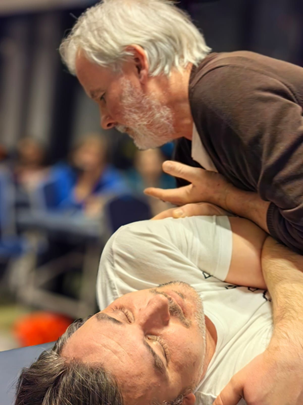
The role of the osteopath during the first 1,000 days, starting from preconception
Responsibility for the health of future generations
De-facilitation of spinal segments
Neurotraffic stimulation: viewing the body through a neurological lens
Vortex technology: the spiral of life
Transformational perspective: Theory U by Otto Scharmer (MIT) and its link with the still point
Methodology of Theory U as a process of transformation
An unconventional didactic approach: open heart, open mind — moving from intellectual listening to deeper perception
What defines a positive approach: growth in response to stimulus, shifting from pathogenesis to salutogenesis
A holistic framework based on four pillars: biomechanics, psycho-emotional factors, biochemistry, and context
Detoxification and trauma sensitivity
Epigenetic and systemic approaches
The mother as a natural ambassador of health
The biomechanical pillar: the woman versus the pregnant woman
The biomechanical development of the child in utero (e.g., ossification of the skull, fetal motion and vitality)
The psycho-emotional pillar: stress and its impact on both mother and fetus
The biochemical pillar: nausea, nutrition, and their relationship to fetal development
Context as a dominant pillar (e.g., father, grandparents, social network)
The birth process
Biomechanical aspects (e.g., nasal breathing)
Psycho-emotional aspects (e.g., muscle tone, crying patterns)
Facilitated segments and resilience
Biochemical aspects (e.g., maternal fatigue)
Contextual factors (micro-, meso-, and macro-environment)
Perspectives of both mother and child
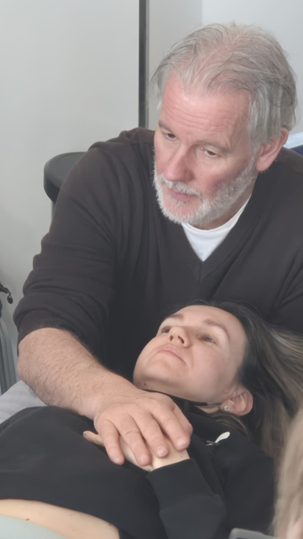
An unconventional didactic approach: interaction, experiential learning, and practical application
The energetic axis within the seven osteopathic axes
The concept of the “constant inconstant”
Combining infinity and expansion
Materialization and dematerialization in osteopathic perception and practice
The six powers of energy
The four powers of true love within the Polyvagal Theory
Insight into and practical application of masculine and feminine energy
Life and death as the starting point of osteopathy — an encounter with life itself
Insight as primary to technique
Vorsprung durch Technik: from progress through technology to innovation through understanding
From nature (e.g., whirlpools, aerodynamics) to osteopathic culture
For many osteopaths, the Still Point is the Valhalla of osteopathy—highly revered, yet rarely reached. Bert will guide you step by step along the path: the highway to the Still Point.
A protocol for reaching the Still Point
Applying Otto Scharmer’s Theory U
The nirvana of osteopathy
Creating the Still Point through the figure-of-eight
Returning to the moment prior to the lesion
Entering into dialogue with the tissues
The importance of the practitioner’s therapeutic foundation (e.g., visualization and intention)
Discover the highway to your own potential
How can you support your patients in preparing for pregnancy?
How can you help them shift from absenteeism to presenteeism?
How can both father and mother “clean their house” — physically, emotionally, and systemically?
How can you help create a “warm house”? How do you support healthy mucosal function and vitality?
How can you teach patients to cope with stress in today’s world?
How do you approach work–life balance? Should life stop at work — or is work simply part of life? “I don’t have a job; I have a life.” Or do I?
What percentage of health is determined by context — and how can you work with it therapeutically?
How can a nightmare be understood as orthosympathetic hypertonia, and how can this condition be treated?
How can we understand shame — as a freeze response, dorsal vagal dominance, or something else entirely?